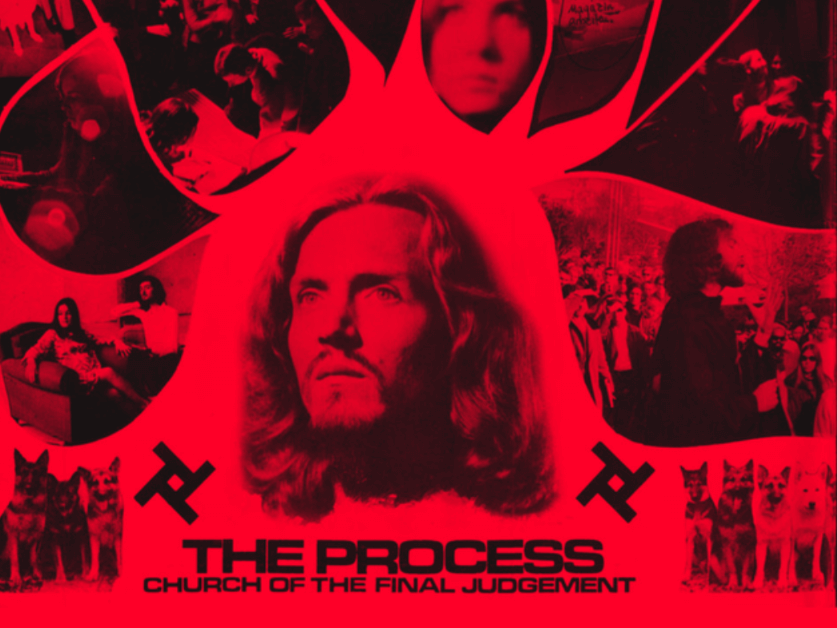
The Process Church of The Final Judgment has long captured public imagination. Allegations of animal sacrifice, ritual murders, and links to infamous figures like Charles Manson and David Berkowitz have made the group a lightning rod for sensational speculation. But beyond the rumors, genuine intersections between the cult and the counterculture’s darkest figures exist.
Founded in the United Kingdom in the early 1960s by Robert Moor and Mary Ann MacLean, The Process began as a splinter group of the Church of Scientology. Initially a psychoanalytic spiritual movement, it evolved into an esoteric entity embracing an apocalyptic worldview.
By the mid-1960s, the group had established a rigid hierarchy. Moor and MacLean, now calling themselves the De Grimstons, were collectively known as “The Omega,” symbolizing ultimate authority. Beneath them, a class system of Masters, Priests, Prophets, and Messengers governed the community of 150 to 200 people.
Their theology centered on the “Final Judgment,” a cosmic battle where Christ and Satan were viewed as dualistic partners. Crucially, they taught that death was not an end, but a transition—a concept that would later mirror Charles Manson’s own teachings.
Manson Territory: Haight-Ashbury
In 1967, The Process expanded to the United States, establishing a Chapter House in San Francisco during the height of the countercultural revolution. The Haight-Ashbury district was a breeding ground for radical ideas, drug experimentation, and spiritual exploration. It was also the stomping ground of Charles Manson.
Freshly released from prison that same year, Manson drifted into the Haight to assemble his so-called “Family.” Remarkably, the two groups operated on the same street.
In December 1967, The Process moved into a house on Cole Street. Manson had been staying at an address just a four-minute walk away. While Manson reportedly left the area shortly before The Process officially established their residence, the geographic overlap is significant. The Process later acquired properties on Oak Street and Geary Street, both within the immediate vicinity of Manson’s former haunts.
Victor Wild: The Missing Link?
While The Process officially denied associating with Manson, a man named Victor Wild (known as Brother Ely) serves as a compelling link. According to author Ed Sanders, Wild joined The Process in San Francisco after a vision on LSD led him to their door.
When the main body of The Process moved on to Los Angeles and then New York, Wild went underground. His girlfriend, Leslie Bouffard, told police that Wild formed a splinter group centered around a leather shop in San Jose. This group courted outlaw motorcycle clubs, a strategy that paralleled Manson’s efforts to recruit the “Straight Satans” biker gang as enforcers.
Bouffard alleged that Wild’s relationship with Manson went beyond casual acquaintance. Manson reportedly wore buckskin clothing made by Wild at the time of his 1969 arrest. Furthermore, Bouffard claimed to have seen Manson Family members Susan Atkins, Patricia Krenwinkel, and Steve Grogan at Wild’s shop. She described Wild’s splinter group as heavily armed and accused them of training German Shepherds as attack dogs.
The Scientology Connection
Another concrete link between the Manson Family and The Process is their shared roots in Scientology. Both groups borrowed heavily from L. Ron Hubbard’s techniques to control members and manipulate beliefs.
Bruce Davis, often described as Manson’s right-hand man, had a direct connection to the organization. From November 1968 to April 1969, Davis studied at the Hubbard Institute of Scientology in London—the very same headquarters where Process founders Robert Moor and Mary Ann MacLean had trained. Davis is currently serving a life sentence for the murders of Donald Shea and Gary Hinman.
Manson himself studied Scientology in prison, reportedly boasting to fellow inmates that he had reached the level of “Theta Clear.” He incorporated auditing techniques into his own method of breaking down and rebuilding his followers’ psyches.
Direct Contact: The Jail Visit
Perhaps the most undeniable connection occurred after the Tate-LaBianca murders. Prison records reveal that two members of The Process, Father John and Brother Matthew, visited Charles Manson in jail.
Process member Hugh Mountain later explained the visit as a pragmatic, if misguided, decision: “We were broke and we thought it would help sell the magazine. We also hoped it would put all the rumors of our association with Manson to rest, but it only stoked them.”
The visit resulted in The Process magazine featuring an article written by Charles Manson in its 1971 “Death” issue. During the subsequent trial, prosecutor Vincent Bugliosi asked Manson if he knew Robert Moor, also known as De Grimston. Manson denied knowing “De Grimston” but admitted to meeting “Moor.” Bugliosi reported that Manson added, “You’re looking at him. Moor and I are one and the same.”
The Hollywood Occult Connection
Both groups aggressively courted fame. The Process attempted to cultivate relationships with figures such as Miles Davis, George Clinton, Salvador Dalí, and Stan Lee, while Manson pursued connections with the Beach Boys, Mike Deasy, Neil Young, and Terry Melcher.
During their time in New York, The Process rented a house from actress Ruth Gordon, who had famously portrayed a Satanist in Roman Polanski’s Rosemary’s Baby. Polanski was married to Sharon Tate at the time. Their neighbors included Hollywood icons Anthony Quinn on one side and Katharine Hepburn on the other, placing the group in a uniquely high-profile environment.
This web of connections extended to the Rolling Stones, the Beatles, and the elite circles of London, where the lines between aristocracy, rock stars, and the occult began to blur.
One socialite, a friend of Sharon Tate, formed an indirect link between the Process Church and the Manson Family.
The Link Between Tara Browne and Sharon Tate
The connection begins with Tara Browne, a prominent London socialite and heir to the Guinness fortune. Browne moved within the orbit of the Process Church, a detail documented by Britt Collins in Paw Prints of Darkness.
A central figure in 1960s counterculture, Browne was a close friend of Sharon Tate, to whom he reportedly gave a dog named Guinness.
Close to both the Rolling Stones and the Beatles, Browne served as a vital social hub, introducing Paul McCartney to LSD and hosting a twenty-first birthday party attended by Mick Jagger, Brian Jones, and Anita Pallenberg.
(Sharon Tate, who had her own ties to the Beatles’ circle, also reportedly named another dog, Prudence, after the song “Dear Prudence” from the White Album.)
Tara Browne and members of the The Rolling Stones were also associated with filmmaker Kenneth Anger, who would later serve as a connective figure between the Stones and the Manson Family. According to Tony Sanchez, who worked for Keith Richards, the group listened “spellbound” as Anger introduced them to occult ideas.
In 1966, Tara Browne died at twenty-one in a car accident—a tragedy John Lennon cited as the inspiration for A Day in the Life (“He blew his mind out in a car”). The tragedy also touched the Rolling Stones’ inner circle: model Suki Potier survived the crash that killed Browne, later dated Stones guitarist Brian Jones, and died in her own car accident in 1981.
From The Rolling Stones to the Manson Family
Besides his connection to Tara Browne, Mick Jagger had his own ties to The Process Church through his friendship with member Timothy Wyllie (Father Micah). The connection deepened through Jagger’s girlfriend, Marianne Faithfull, who was actively involved with The Process Church. Faithfull appeared on the cover of the church’s second magazine Freedom of Expression, while Jagger was featured on the cover of the third issue, the Mindbending edition.
This influence manifested in Sympathy for the Devil, a track inspired by a book Faithfull gave Jagger and likely informed by The Process’s teachings on the reconciliation of Christ and Satan. Faithfull also provided backing vocals on that track and on the Beatles’ Yellow Submarine, a song linked to the Manson Family—who named one of their homes after it.
The connection to the Manson Family crystallized through Faithfull, who starred in Kenneth Anger’s occult film Lucifer Rising. The soundtrack, initially composed by Mick Jagger, was replaced by music from Bobby Beausoleil, a Manson Family member later sentenced to life for the murder of Gary Hinman. Beausoleil was originally slated to star in the film, but after a falling-out, the role went to Chris Jagger, Mick’s brother.
From Mick Jagger to Anton LaVey
Mick Jagger’s rejected music later appeared in Anger’s Invocation of My Demon Brother, which also featured Bobby Beausoleil and Anton LaVey, founder of the Church of Satan—active in San Francisco alongside The Process and Charles Manson.
Susan Atkins, later convicted for her role in the Tate-LaBianca murders, worked with LaVey before joining the Manson Family. Both LaVey and Anger were disciples of the work of Aleister Crowley. Timothy Wyllie, a member of The Process, also referenced Crowley repeatedly in his book Love, Sex, Fear, Death.
Crowley’s influence provided a “shared DNA” for many fringe groups of the era. His work reportedly inspired L. Ron Hubbard, the founder of Scientology, whose early methodologies heavily informed the development of both The Process Church and the ideological framework of Charles Manson.